Key facts
- Google states that its generative features run on the existing Search index and ranking systems, and that a page must be indexed and eligible for a normal snippet before it can appear in an AI answer (Google Search Central).
- Around 30% of UK Google searches now return an AI summary, and up to 34% of non-branded searches (Ofcom, Online Nation 2025).
- In US browsing data, users clicked a standard search result on 8% of visits where an AI summary appeared, against 15% where none did (Pew Research Center). This is US data.
- Citing sources, adding quotations and adding statistics each raised visibility by 30 to 40% in a 10,000-query benchmark, measured on position-adjusted word count. Keyword stuffing scored roughly 8% below doing nothing at all (Aggarwal and others, ACM SIGKDD, August 2024).
- Three of the five AI models asked about firstmention.co.uk resolved it to an unrelated US company with a near-identical name.
What do SEO and GEO mean?
Search engine optimisation is the work of getting a page to rank in a list of links. Generative engine optimisation, sometimes called answer engine optimisation, is the work of getting a business retrieved, cited and named inside an answer that a model writes. One competes for a position, the other for a mention.
The mechanism matters more than the label. Google's own guidance names two things its generative features do: retrieval-augmented generation, also called grounding, and query fan-out (Google Search Central, 15 May 2026, updated 10 July 2026). Grounding means the model fetches live pages and writes its answer from what they say, rather than from memory. Query fan-out means one typed question becomes several separate searches behind the scenes.
Take a patient typing: "emergency dentist near Totnes who can see a child on Saturday and takes new NHS patients." That is not one search. The assistant may issue four: same-day and emergency appointments in the area, Saturday opening hours, practices treating children, and which practices are accepting NHS registrations. It then writes one answer naming two or three practices.
That changes what a dental practice's website has to do. If the Saturday hours exist only in a photograph of the front door, and NHS status is implied by a friendly line about welcoming new faces, then two of the four sub-queries find nothing to retrieve. The practice may still rank perfectly well for "dentist Totnes", because that is a different question being answered by a different system.
The numbers behind this are large. Google Search handles around 3 billion searches a month in the UK (Ofcom, Online Nation 2025), and a meaningful share of them now return a written answer rather than only a list. Google AI Overviews has passed 2.5 billion monthly active users, and AI Mode has passed 1 billion monthly users (Google, June 2026).
Where they share foundations, and where they diverge
Google is explicit that AEO and GEO are still SEO. Its generative features run on the existing Search index and ranking systems, and a page must be indexed and eligible for a normal snippet before it can appear in an AI answer at all (Google Search Central). Everything that makes a page findable in the conventional sense is a precondition, not an alternative.
That overlap is real, and it is also the limit of the overlap, for two reasons. First, Google's guidance describes Google Search. It says nothing about ChatGPT, Perplexity or Claude, and a large share of UK AI use now sits there: ChatGPT alone recorded 1.8 billion UK visits in the first eight months of 2025, up from 368 million in the same period of 2024 (Ofcom, Online Nation 2025). Second, sharing an index does not mean sharing an outcome: ranking is a judgement about a page, while being named in an answer is a judgement about a business.
| What conventional SEO work covers | What AI visibility work adds |
|---|---|
| Being indexed and eligible for a normal snippet | Being retrievable as the answer to a single sub-query |
| Ranking position for a target phrase | Whether the business is named in the written answer at all |
| Googlebot access | GPTBot, PerplexityBot and Google-Extended access |
| Keyword and topic coverage | Whether individual facts are stated in plain, findable text |
| The site recognised as a set of pages | The business resolved as an entity, distinct from similarly named ones |
| Rank tracking and traffic reporting | Repeat prompting across several assistants |
Nothing in the right-hand column is measured by the left, and none of it fails in a way anyone notices at the time.
What does the AI-specific work consist of?
There are four parts, and a conventional ranking report covers none of them.
Entity resolution. In other words, whether an assistant can reliably tell your business apart from similarly named ones, and then describe it accurately. Suppose a family law firm in Exeter shares most of its name with a larger firm in Manchester. An assistant asked for a solicitor in Devon may merge them, and answer with the Exeter firm's name attached to the Manchester firm's opening hours, partners and practice areas. The work here is consistent naming everywhere the business appears, organisation markup generated from the text visible on the page, verified external profiles, and plain statements of town, county and country. A ranking report has no field for "described as a different company".
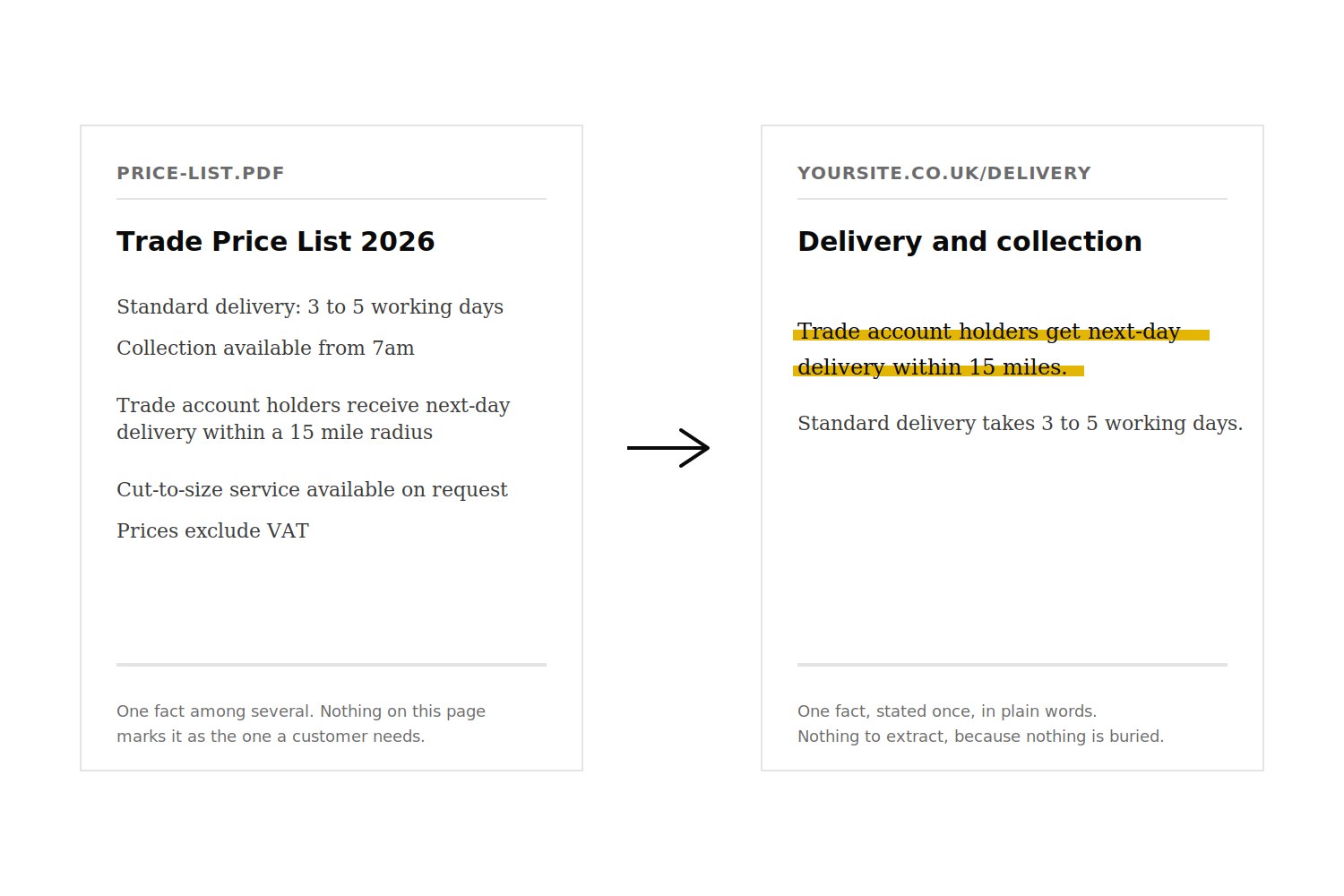
Extractability. This means whether the facts a customer needs exist as findable, plainly worded text, rather than being implied, buried inside a general page, or held only in an image or a PDF. A builders' merchant near Newton Abbot may have a delivery radius, trade account terms and a cut-to-size service, all of them stated in a downloadable price list. Because of query fan-out, a different sub-query may go looking for each of those facts, and a PDF attachment is a poor place to be retrieved from. Brevity helps too. Generated answers are short and they draw on several sources at once, so a fact stated in one plain sentence has a better chance of surviving into the answer than the same fact spread over a paragraph.
Crawler accessibility. AI crawlers have to be permitted in robots.txt, the text file at the root of a site that tells automated visitors which parts they may read. GPTBot, PerplexityBot, Google-Extended and similar are separate from Googlebot, and blocking them removes the business from those assistants entirely. Many website platforms and hosts set these defaults without telling the owner. Suppose a hotel near Salcombe moves to a new site build one weekend. Its Google rankings can be unchanged on Monday morning while it has dropped out of assistant answers, because a default in a configuration file decided the matter. Blocking an AI crawler is a publishing decision rather than a technical safety measure, and it is worth making deliberately.
Evidence density. The question here is whether pages carry attributable facts, figures and sources. The first controlled experiment on this, run against a 10,000-query benchmark, found that citing sources, adding quotations and adding statistics each raised visibility by 30 to 40% on position-adjusted word count (Aggarwal and others, ACM SIGKDD, August 2024). The 40% is a maximum, not an average. The same study found that keyword stuffing scored roughly 8% below doing nothing at all, which means a long-standing habit is working against the business paying for it. A later preprint held the wording identical and changed only structure, hierarchy and chunking, and reported citation rates rising 17.3% across six generative engines (Yu and others, 31 March 2026). That paper has not been peer reviewed and does not name the six engines, so treat it as directional. In practice, this is the difference between a dental page promising excellent results at affordable prices and one that states the material used, the number of appointments and the price.
Citation is also dispersed rather than concentrated. Reddit was the most-cited domain in Google AI Overviews and appeared in only 2.2% of responses, against 6.6% for Perplexity and 1.8% for ChatGPT (Ofcom, Online Nation 2025). No single site owns the answers, which is why an ordinary business page carrying attributable facts has a route in.
For Google Search, Google also lists things site owners can ignore: llms.txt and other special machine-readable files, chopping content into small pieces, rewriting pages specifically for AI, chasing inauthentic mentions, and over-focusing on structured data (Google Search Central). There is no special schema that makes a page eligible for AI Overviews or AI Mode.
How do you measure whether an assistant recommends you?
By asking it, repeatedly, and writing down what it says. The method is a fixed set of queries, run monthly, with each query asked five times within the run, across the major assistants rather than one. Answers vary between models, and they vary between runs of the same question on the same model, so a single answer is an anecdote rather than a measurement.
Ask "best commercial property solicitor in Exeter" five times in one week and you may get five overlapping but different sets of names. One appearance is not visibility, and one absence is not failure. Repeat runs are what let you compare month to month, and they are also what tells you whether a business is named consistently or occasionally.
What gets recorded matters as much as how often. Record not only whether the business was named, but how it was described, which page was cited, and whether the description was accurate.
Checking one assistant is not the same as checking the field. In the year to August 2025, assistants grew from smaller bases at very different rates: Gemini up 146%, Claude up 138% and Perplexity up 100% (Ofcom, Online Nation 2025).
A conventional ranking report cannot substitute for this, because it records a position in a list of links. It says nothing about whether a name appeared in a written answer, and for ChatGPT or Perplexity there is no ranking position to report in the first place. Traffic reporting understates the picture too: a customer who reads an answer, forms a view and acts on it later may leave no trace at all in an analytics account.
The firstmention.co.uk five-model entity test
First Mention ran the test on its own domain. Five AI models were asked about firstmention.co.uk. Three of the five resolved it to firstmention.co, an unrelated US home-services SEO firm, and one attributed that company's content to First Mention. First Mention is based in Devon and has no connection to firstmention.co.
This is an ordinary failure rather than an exotic one. The domain is spelled correctly. The site is indexed. Nothing is broken in any sense a conventional audit would flag. The models simply had a near-identical name in front of them, more material attached to the other one, and no unambiguous signal about which business sat in Devon and which sat in the United States.
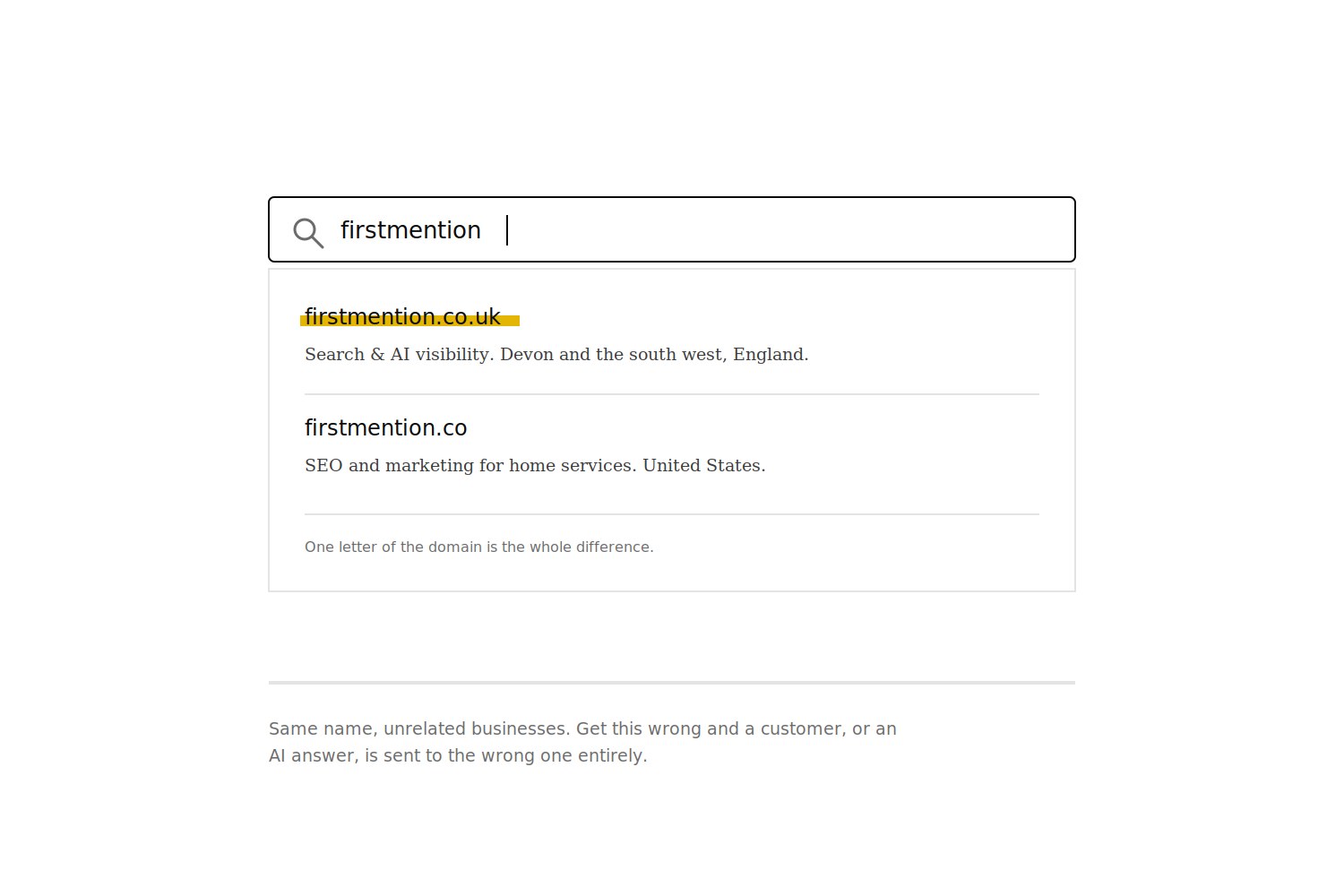
No ranking report contains a row for "confused with a company on another continent", and no traffic report shows the enquiries that went elsewhere because the answer described the wrong firm. The only way to find it is to ask the models directly and read what comes back.
The fix is identifiable work rather than a trick. Write the business name in full and identically everywhere it appears. State the country and county plainly on the page, rather than leaving them to be inferred from a phone number. Generate organisation markup from that visible text, keep external profiles verified and in agreement with each other, and publish enough distinct first-hand material that a model has something specific to attach to the name.
Any business in the south west of England with a common name has the same problem. A Riverside Dental or a Harbour Inn is competing for its own identity before it competes for anything else.
Questions people ask
Should I get the SEO right first and worry about AI later?
They are not sequential. The foundations are shared, so the indexing and crawlability work supports both at once, but entity resolution, crawler permissions and measurement do not happen as a by-product of ranking work. Leave them until later and the period in between is spent being described by assistants without knowing how. The usual order within one programme is: check how assistants currently describe the business, fix crawler access and naming, then work on extractability and evidence page by page. Measurement starts at the beginning, because a baseline taken afterwards tells you nothing.
Is GEO just SEO with a new name?
They share foundations, and Google's guidance supports treating them as one programme rather than two suppliers. What differs is real and measurable: how a business is named and resolved as an entity, whether its facts are extractable from the page, whether AI crawlers can reach it, and how visibility is measured once conventional rankings stop deciding who gets recommended.
Can I rank first on Google and still be invisible in AI answers?
Yes. Ranking first means a page won a position in a list. An assistant answering a question runs several sub-queries, retrieves what it can read, and names the businesses whose facts it found. If the facts sit in a PDF, or the crawler is blocked, or the business is confused with another, a good rank does not rescue it. This is the most common gap between what a business pays to measure and what its customers see.
How would I know if an AI assistant is describing my business wrongly?
Only by asking it, several times, across different assistants, and recording the answers. An AI visibility audit from First Mention costs £950 and covers a fixed query set run five times each across the major assistants, an analysis of how the business is currently described and cited, and an in-person meeting to go through the findings. Models are inconsistent, so a wrong description that appears in two runs out of five is still a wrong description that some customers are reading.
Do I need an llms.txt file on my website?
Google states that it does not use llms.txt or other special machine-readable files for its generative features, and lists them among the things site owners can ignore for Google Search. Support elsewhere is not established, so it is worth discussing factually rather than buying as a deliverable. The file itself is harmless and cheap to publish, but any claim sold as a route to AI visibility should come with a named source saying that the systems in question read it.
Does FAQ schema help me appear in AI answers?
No. FAQ rich results stopped appearing in Google Search on 7 May 2026, and Google removed the supporting documentation on 15 June 2026. Eligibility had already been limited to well-known government and health sites since August 2023. FAQPage remains a valid schema.org type and unused structured data causes no harm. The work is done by the visible question and answer text on the page, because that is what gets retrieved and quoted.
My customers are older. Does any of this reach them?
Yes, largely without them choosing it. Adoption is concentrated among younger adults, at 79% of 16 to 24 year olds and 74% of 25 to 34 year olds, and 54% of UK adults now use AI tools such as ChatGPT, Copilot or Gemini, up from 31% the year before (Ofcom, Adults' Media Use and Attitudes, 2 April 2026). But AI summaries arrive in ordinary Google results whether or not the person went looking for an assistant, and 53% of UK adults say they see them often (Ofcom). A customer who would never open ChatGPT still reads a written answer at the top of the page, and that answer names some businesses and not others.
More answers are on the First Mention FAQ hub.
What to do next
Start by finding out how assistants currently describe your business, because everything else follows from what comes back. First Mention is a search and AI visibility consultancy in Devon, serving the south west of England, and opens in the first quarter of 2027. The £950 AI visibility audit covers a fixed query set run repeatedly across the major assistants, an analysis of how the business is currently described and cited, and a meeting in person to go through the findings.
Check visibilitySources
- Ofcom, Online Nation 2025, published 10 December 2025. ofcom.org.uk
- Ofcom, Adults' Media Use and Attitudes, fieldwork 29 September to 28 November 2025, published 2 April 2026.
- Google, “New controls for website owners”, June 2026. blog.google
- Google Search Central, “Optimizing your website for generative AI features on Google Search”, published 15 May 2026, updated 10 July 2026. developers.google.com
- Google Search Central, FAQPage structured data documentation. developers.google.com
- Pew Research Center, “Google users are less likely to click on links when an AI summary appears in the results”, 22 July 2025. pewresearch.org
- Aggarwal, Murahari, Rajpurohit, Kalyan, Narasimhan and Deshpande, “GEO: Generative Engine Optimization”, ACM SIGKDD, August 2024. arxiv.org
- Yu, MuFeng, Ding and Sato, “Structural Feature Engineering for Generative Engine Optimization”, 31 March 2026. arxiv.org