Key facts
- ChatGPT recorded 1.8 billion UK visits in the first eight months of 2025, up from 368 million in the same period of 2024 (Ofcom, Online Nation 2025, published 10 December 2025).
- 54% of UK adults use AI tools such as ChatGPT, Copilot or Gemini, up from 31% the year before (Ofcom, Adults' Media Use and Attitudes 2026, published 2 April 2026).
- Google AI Overviews has passed 2.5 billion monthly active users and AI Mode has passed 1 billion monthly users (Google, 3 June 2026).
- OpenAI documents four separate crawler user agents and states that sites opted out of OAI-SearchBot will not be shown in ChatGPT search answers (OpenAI, Overview of OpenAI Crawlers).
- Google's crawler documentation, updated 14 July 2026, states that Google-Extended does not affect a site's inclusion in Google Search and is not used as a ranking signal there.
- From 15 September 2026, Cloudflare will block Training and Agent crawlers by default on ad-displaying pages for newly onboarded domains, while allowing Search crawlers (Cloudflare, 1 July 2026).
AI crawlers are not one thing, and one company runs several of them
“AI crawler” covers at least three different jobs, and the major companies run a separate bot for each. Training crawlers collect pages to build future models. Search crawlers build the index that sits behind an assistant's answers. User-triggered fetchers visit a single page because a person asked the assistant to look at it.
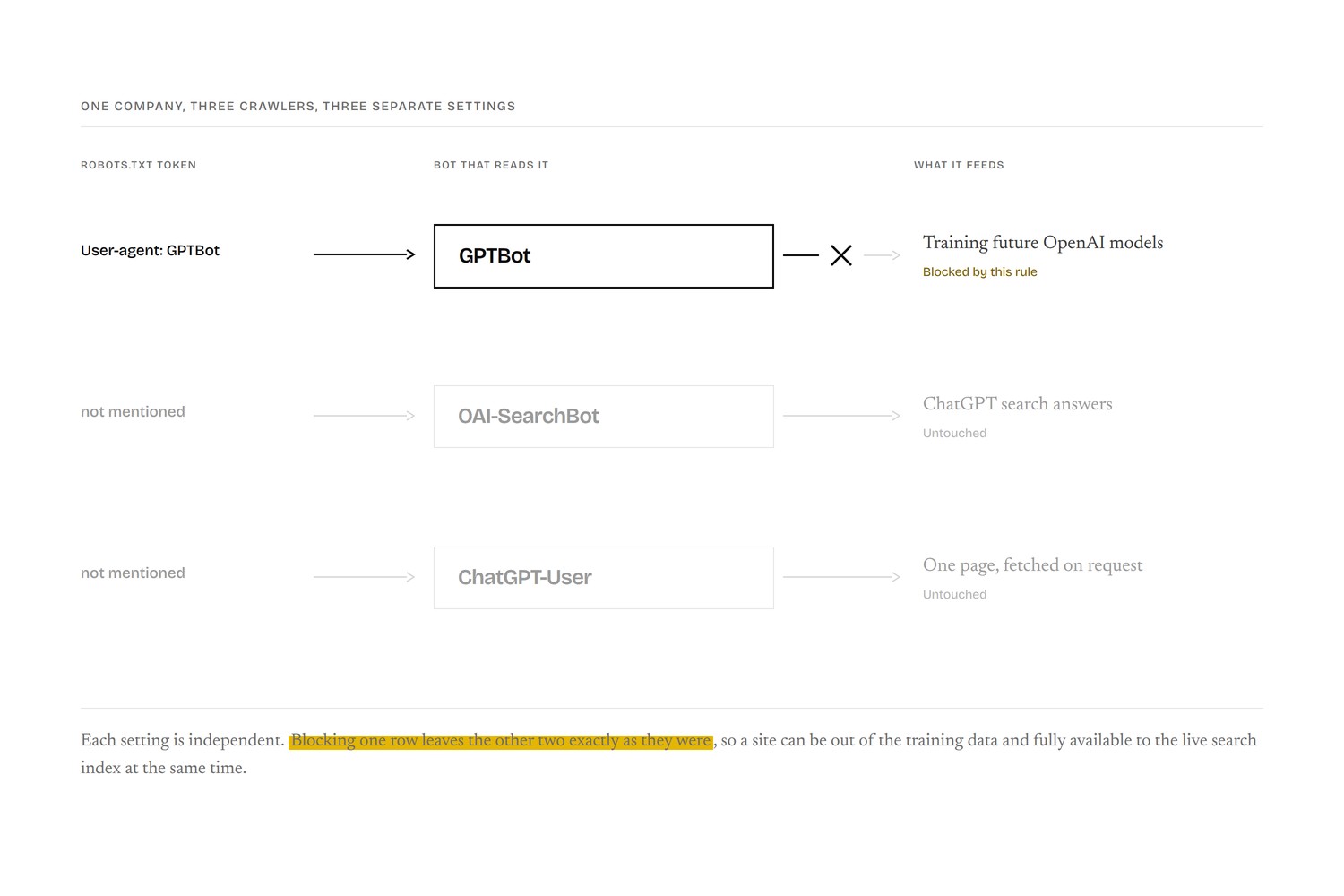
Each bot announces itself with a user agent, the name it gives when it asks your server for a page. Those names are what robots.txt rules match on. OpenAI documents four: GPTBot for training, OAI-SearchBot for ChatGPT's search features, ChatGPT-User for user actions, and OAI-AdsBot for pages submitted as adverts. Perplexity documents two, PerplexityBot and Perplexity-User. OpenAI states plainly that each setting is independent of the others.
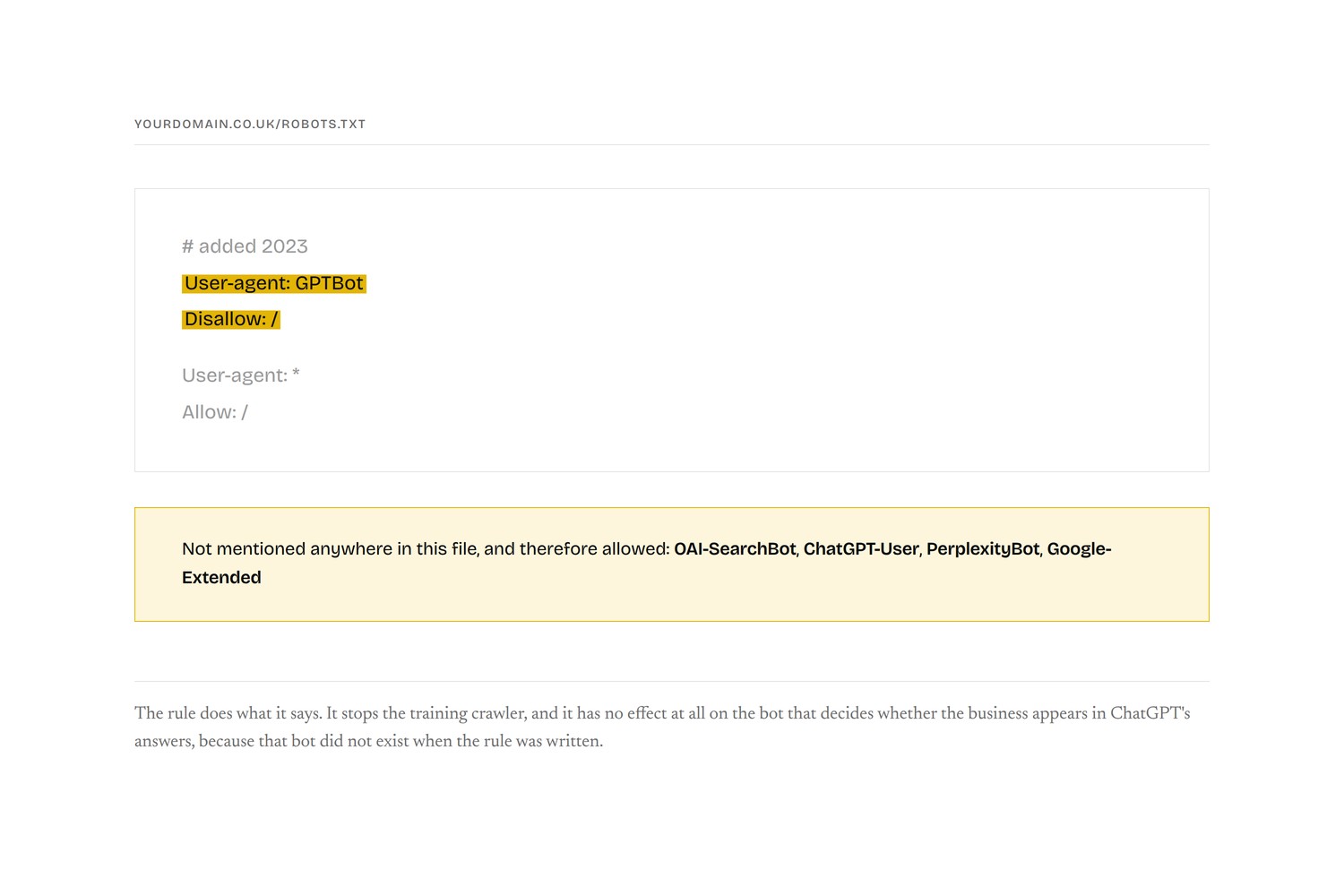
Say a dental practice in Exeter blocked GPTBot in 2023, on the reasonable view that its treatment pages should not train someone else's model. That block did what it was meant to do. It did nothing at all to ChatGPT's search answers, because those run through OAI-SearchBot, a bot that did not exist when the rule was written and is not covered by it. The practice is out of the training data and fully available to the live search index at the same time, which is a coherent position, though probably not one anybody chose.
What blocking each control does
The controls named most often do unrelated things, and only one of them takes a business out of an assistant's answers.
| Control | What blocking it removes | What it leaves untouched |
|---|---|---|
| GPTBot | Use of your pages in training future OpenAI foundation models | ChatGPT search answers, which run on OAI-SearchBot |
| OAI-SearchBot | Your site being shown in ChatGPT search answers | Google, Bing and every other engine |
| PerplexityBot | Full and partial page text being indexed for Perplexity answers | Domain, headline and a brief factual summary, which Perplexity says it may still index |
| Google-Extended | Use of your content to train Gemini models, and grounding in Gemini apps and Vertex AI | Google Search, including AI Overviews and AI Mode |
Google-Extended is the one most often misread, partly because it is not a crawler. Google's documentation describes it as a standalone product token, a name that exists only inside robots.txt as a control. No bot sends it as a user agent, and crawling continues with the usual Google agents.
A builders' merchant near Plymouth might block Google-Extended expecting the AI summary above its listing to stop appearing. Nothing changes on the results page. Google's guidance on generative AI features, published 15 May 2026 and updated 10 July 2026, states that those features run on the existing Search index and ranking systems, and that a page must be indexed and eligible for an ordinary snippet before it can appear in an AI answer at all. What the merchant has changed is whether its stock and delivery information helps train Gemini and ground answers in the Gemini apps. That may be exactly what it wanted, but it is not what it thought it was buying.
The decision may already have been made for you
Most owners have never opened their robots.txt file, but something has usually written to it, or to the layer above it. Crawler policy is now a default set by hosting providers, content delivery networks and security services, and those defaults move.
Cloudflare, which sits in front of more than 20% of web domains by its own account, launched one-click AI bot blocking in July 2025. On 1 July 2026 it replaced that single switch with three separate categories: Search, Agent and Training. It also offers a managed robots.txt that prepends a Content-Signal line stating that crawling for search is acceptable and crawling for training is not. An owner reading their own file will find wording nobody at the business wrote.
The part worth diarising is 15 September 2026. From that date, for newly onboarded domains and pages that display adverts, Cloudflare will block Training and Agent crawlers by default while leaving Search allowed. Multi-purpose crawlers will be judged on all of their behaviours at once, and Cloudflare names Googlebot, Applebot and Bingbot as examples that will be blocked for anyone who has chosen to block Training, including through the older switch.
Consider a hotel near Salcombe whose developer ticked “Block AI Bots” in 2025 and has since moved on. Nobody at the hotel has looked at that dashboard since. The setting has not changed, but the classification beneath it has, and the same tick now reaches crawlers it did not reach before. A network-level block is also stronger than a robots.txt rule: Cloudflare's own post distinguishes between signals in robots.txt, which express a preference, and blocking, which stops the request. The hotel's robots.txt could be perfectly permissive and still be irrelevant.
How to check what your site is telling AI crawlers
Start with the file itself. Open yourdomain.com/robots.txt in a browser, since it is a public text file on every site, and look for the specific tokens: GPTBot, OAI-SearchBot, ChatGPT-User, PerplexityBot, Perplexity-User, Google-Extended. A token that appears nowhere is allowed. A token under a Disallow rule is blocked, and the block applies only to the paths listed after it.
Then check the layer above, because that overrides the file. If the site sits behind a content delivery network or a security service, its bot settings decide whether the request reaches your server in the first place. Look for anything labelled AI bots, bot fight, or managed rules, and read what each category now covers rather than trusting a label chosen a year ago.
Server logs settle the question that dashboards cannot. Search the logs for the user agent strings and see which bots have arrived, how often, and what status codes they received. Repeated 429 or challenge responses mean the crawler is being turned away by rate limits rather than by policy. Because a user agent header can be typed by anyone, verify the requests against the published address lists: OpenAI publishes ranges at openai.com/searchbot.json and openai.com/gptbot.json, and Perplexity at perplexity.com/perplexitybot.json.
A law firm in Truro doing this properly would finish with three things: a robots.txt it can explain line by line, a security dashboard whose settings it chose deliberately, and log evidence of which assistants have read which pages. Allow time for changes to take effect, since both OpenAI and Perplexity say it can take around 24 hours for a robots.txt update to register. Google, meanwhile, began testing a Search Console toggle on 3 June 2026 that lets owners decide whether their site appears in and helps ground its generative Search features, alongside new impression data for those features. It is being rolled out to a subset of UK website owners first, so it is worth looking for.
What a block does not protect
Blocking is a publishing choice about who may quote you. It is a weak tool for anything else.
The file is public, and it is a request rather than a lock. Anyone can read yourdomain.com/robots.txt, which means a list of disallowed paths is also a list of the pages you would rather not draw attention to. Compliant crawlers honour it. Nothing enforces it.
Blocking also works forwards only. A rule added today does not remove content from models that were trained last year. Partial visibility often survives too: Perplexity states that a page blocked in robots.txt may still be indexed by domain, headline and a brief factual summary, and OpenAI states that a site opted out of OAI-SearchBot can still appear as a navigational link. User-triggered fetchers are a separate case again. Perplexity says Perplexity-User generally ignores robots.txt because a person requested the fetch, and OpenAI says the same rules may not apply to ChatGPT-User.
If material genuinely must not be read by anyone, the controls are authentication or removal, not a crawler token. Removal has a trap in it: a noindex tag can only work if the crawler is allowed to fetch the page and read the tag, so blocking the crawler and adding noindex defeat each other.
Being reachable is not the same as being described correctly
An open crawler policy makes a business eligible to be named. It does not make the naming accurate.
When First Mention tested how AI assistants described its own domain, three of five models resolved firstmention.co.uk to firstmention.co, an unrelated home-services SEO firm in the United States, and one of them attributed that company's content to First Mention. No crawler was blocked. Every page was reachable. The models simply could not tell two similarly named businesses apart, and confidently described the wrong one.
That is entity resolution: whether an assistant can reliably identify your business as distinct from others and describe it correctly. The work behind it is unglamorous and specific. It means naming the business identically everywhere it appears, generating organisation markup from the text visible on the page, verifying the external profiles that models cross-reference, and stating location and country without ambiguity. A hotel called The Ship, a dental practice sharing a surname with three others in the county, and any business whose domain resembles a larger one elsewhere all carry this risk. Nothing in a conventional ranking report will show it, because the pages can rank perfectly well while the description attached to them is somebody else's.
Common questions
Will blocking AI crawlers hurt my Google rankings?
Blocking Google-Extended will not. Google's crawler documentation states that it does not affect a site's inclusion in Google Search and is not used as a ranking signal there. The risk sits elsewhere: a network-level rule that blocks Googlebot itself will stop Google crawling you, and a site Google cannot crawl does not stay indexed.
This is the specific reason the 15 September 2026 Cloudflare change is worth checking rather than ignoring. Multi-purpose crawlers will be judged on all their behaviours, so a setting chosen to block training can reach a bot that also handles search. A switch nobody has touched can start doing something it did not do before.
Can I stop AI companies training on my content but still appear in their answers?
Yes, and the companies document it as a supported choice. OpenAI gives the example directly: allow OAI-SearchBot so the site appears in ChatGPT search results, while disallowing GPTBot to indicate the content should not be used to train its foundation models. Perplexity states that PerplexityBot is not used to crawl content for AI foundation models at all.
This is the position most businesses want, and almost nobody has configured deliberately. It takes two rules in one file. The common failure is doing half of it, usually by copying a template written before the search crawlers existed.
I blocked these bots a couple of years ago. Does it still matter?
It matters more than it did. A rule written in 2023 names bots that existed in 2023, and the search crawlers that decide whether you appear in AI answers were introduced later. An old file is not neutral, because the tokens it does not mention are allowed by default while the ones it does mention may no longer do what they did.
Adoption has also moved underneath those rules. Ofcom describes AI summaries as largely passive: people are not seeking AI answers so much as being given them. A decision made when this was a niche channel is being applied to a mainstream one.
Someone else built my website. How do I find out what they set?
You do not need their help for the first step. Open yourdomain.com/robots.txt in any browser, because it is a public file, and read what is there. Then ask whoever holds the hosting and security logins what bot settings are enabled, since those sit above the file and can override it entirely.
The two often disagree. A permissive robots.txt tells you nothing if a security service is turning the same crawlers away before the request reaches your site. Server logs are the only record of what happened.
Is robots.txt actually enforceable?
No. It is a published preference that well-behaved crawlers choose to honour, and the major AI companies document that they do. There is no technical barrier behind it, no penalty for ignoring it, and no way to tell from the file alone whether it was obeyed. Server logs are the evidence.
Cloudflare draws this distinction explicitly in its own documentation, describing robots.txt entries as signalling a preference rather than issuing blocks. That is why anything that genuinely must stay private belongs behind a login rather than behind a disallow rule.
Does blocking AI crawlers protect customer data on my site?
Not in any meaningful way. These crawlers fetch publicly accessible pages, so anything they could reach was already reachable by any visitor. Blocking them changes who may quote your public content. It has no effect on data held behind a login, in a booking system, or in your email.
If the concern is confidential material appearing on a public page, the fix is to take it off the public page. Treating a crawler token as a privacy control leaves the underlying exposure exactly where it was.
How would I know whether any of this made a difference?
You would ask the assistants directly and repeatedly. A fixed set of the questions your customers ask, run across the major assistants, each question asked several times, because answers vary between models and between runs of the same question. A single answer proves nothing. A pattern across repeated runs is a measurement.
Conventional rank tracking cannot do this, since it measures a different thing entirely. First Mention runs a fixed query set monthly, asking each query five times within the run, and reviews the results with the client in person or online.
More answers are on the First Mention FAQ hub.
What to do next
Open your robots.txt, check the bot settings in whatever sits in front of your site, and make sure the position you are in is one you chose. If you would rather have the full picture, including how the assistants currently name and describe your business, the First Mention AI visibility audit costs £950 and covers the analysis and an in-person meeting to go through it.
Check visibilitySources
- Ofcom, Online Nation 2025, 10 December 2025. ofcom.org.uk
- Ofcom, Adults' Media Use and Attitudes 2026, 2 April 2026. ofcom.org.uk
- Google, “New opportunities, control and insights for website owners”, 3 June 2026. blog.google
- Google Search Central, “Optimizing your website for generative AI features on Google Search”, 15 May 2026, updated 10 July 2026. developers.google.com
- Google, “List of Google's common crawlers”, updated 14 July 2026. developers.google.com
- OpenAI, “Overview of OpenAI Crawlers”. developers.openai.com
- Perplexity, “Perplexity Crawlers”. docs.perplexity.ai
- Perplexity, “How does Perplexity follow robots.txt?” perplexity.ai
- Cloudflare, “Your site, your rules: new AI traffic options for all customers”, 1 July 2026. blog.cloudflare.com