Key facts
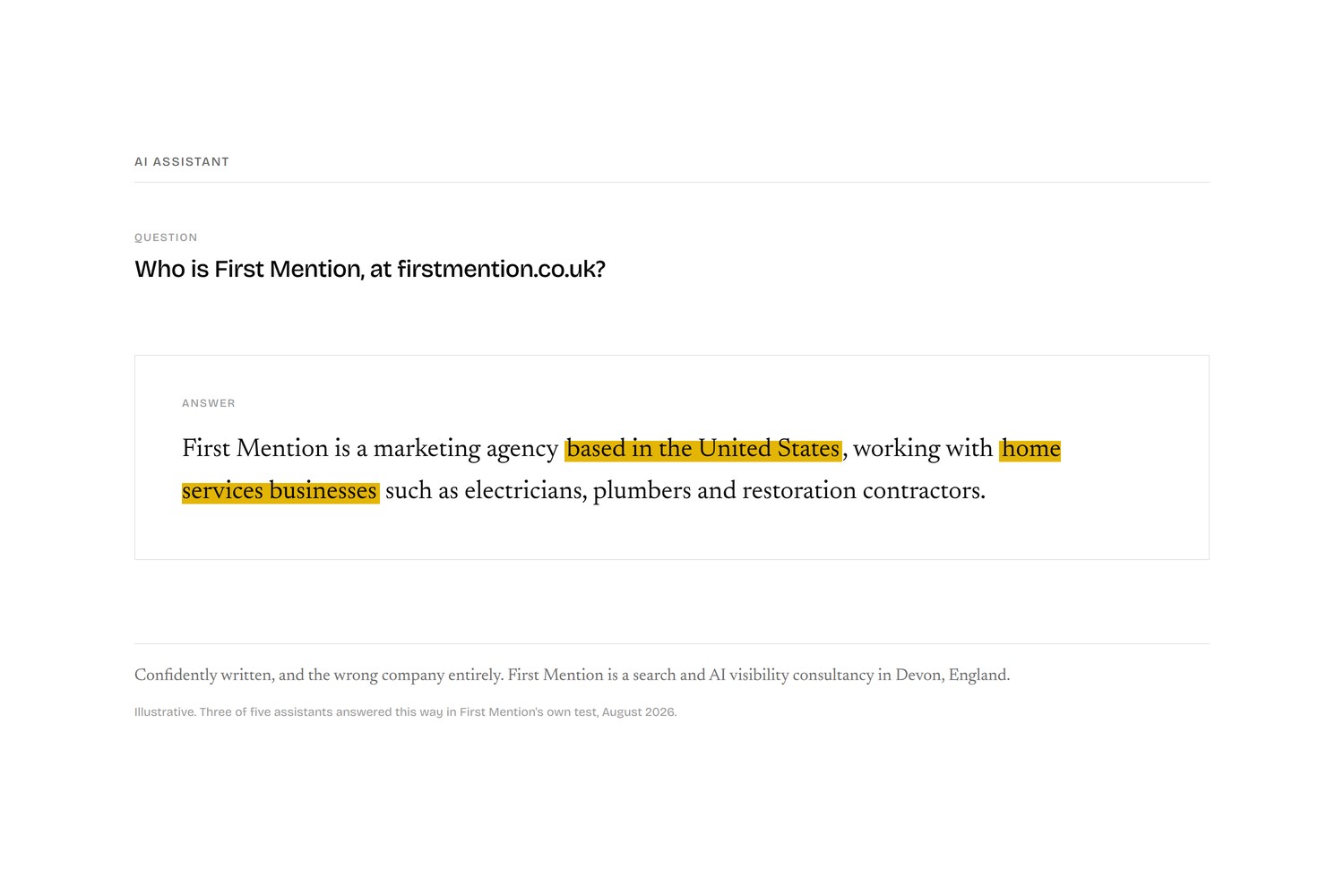
- In August 2026, First Mention put its own domain to five AI assistants. Three answered about firstmention.co, an unrelated US home-services SEO firm, and one attributed that firm's published articles to First Mention.
- Entity resolution is the step where an assistant matches a name to one real thing before retrieving any facts about it. Every sentence of the answer is built on that match.
- A ranking report cannot show an entity failure, because the failure happens on questions that never involve your URL. Positions can read perfectly throughout.
- Answers vary between assistants and between runs of the same question, so a single answer proves nothing. First Mention runs a fixed query set monthly and asks each query five times within the run.
- Google requires no special schema for AI Overviews or AI Mode and does not use llms.txt files. Indexing and eligibility for an ordinary snippet are the entry requirements (Google Search Central, published 15 May 2026, updated 10 July 2026).
- Across 10,000 test queries, citing sources, adding quotations and adding statistics each raised AI visibility by up to 40%, while keyword stuffing scored roughly 8% below making no change at all (Aggarwal and colleagues, ACM SIGKDD, August 2024).
Three of five assistants named the wrong company
In August 2026, First Mention put its own name and domain to five AI assistants, ChatGPT, Claude, Perplexity, Gemini and Google's AI Overviews, and asked what the business was and who ran it. Three of the five answered about a different company. They resolved firstmention.co.uk to firstmention.co, an American home-services SEO firm with no connection to Devon or to this consultancy, and described that firm's work as ours. One went further and attributed that company's published content to First Mention.
Nothing about this looked like a fault. The site was live, indexed and perfectly readable. The assistants had two plausible candidates for one name, and the evidence attached to the American company was older and more densely linked, so they chose it. A model does not tell you it is uncertain. It writes a confident paragraph about whichever entity it settled on.
The reason it happened to us is not mysterious. First Mention is new. The domain is new, the external record behind it is thin, and firstmention.co has been trading and publishing for years. Given two candidates for one name, the assistants took the one with more evidence attached to it, which is the reasonable thing to do on the information available. An SEO consultancy finding this on its own domain is uncomfortable to write down, and it also makes the point better than a borrowed example would: the fault has nothing to do with the quality of the site, only with a thin record standing next to an established namesake. Every new business, every rebrand and every company that shares a name with a bigger one starts in the same place.
The failure was not confined to one product, and the two assistants that answered correctly cannot be relied on to keep doing so, because the same question can resolve differently on a different day.
One clarification belongs in plain text on this page, because it is the fix the rest of the article describes. First Mention is a search and AI search consultancy based in Devon, England, trading at firstmention.co.uk. It has no connection to firstmention.co, a home-services SEO firm in the United States.
That is the whole problem in one example. The failure is silent, it happens before any question about quality or ranking is reached, and the business at the wrong end of it has no way of noticing during ordinary trading. It is also a diagnosable fault with identifiable causes: a near-identical domain, a name that is a common English phrase, and a thin external record.
What is entity resolution?
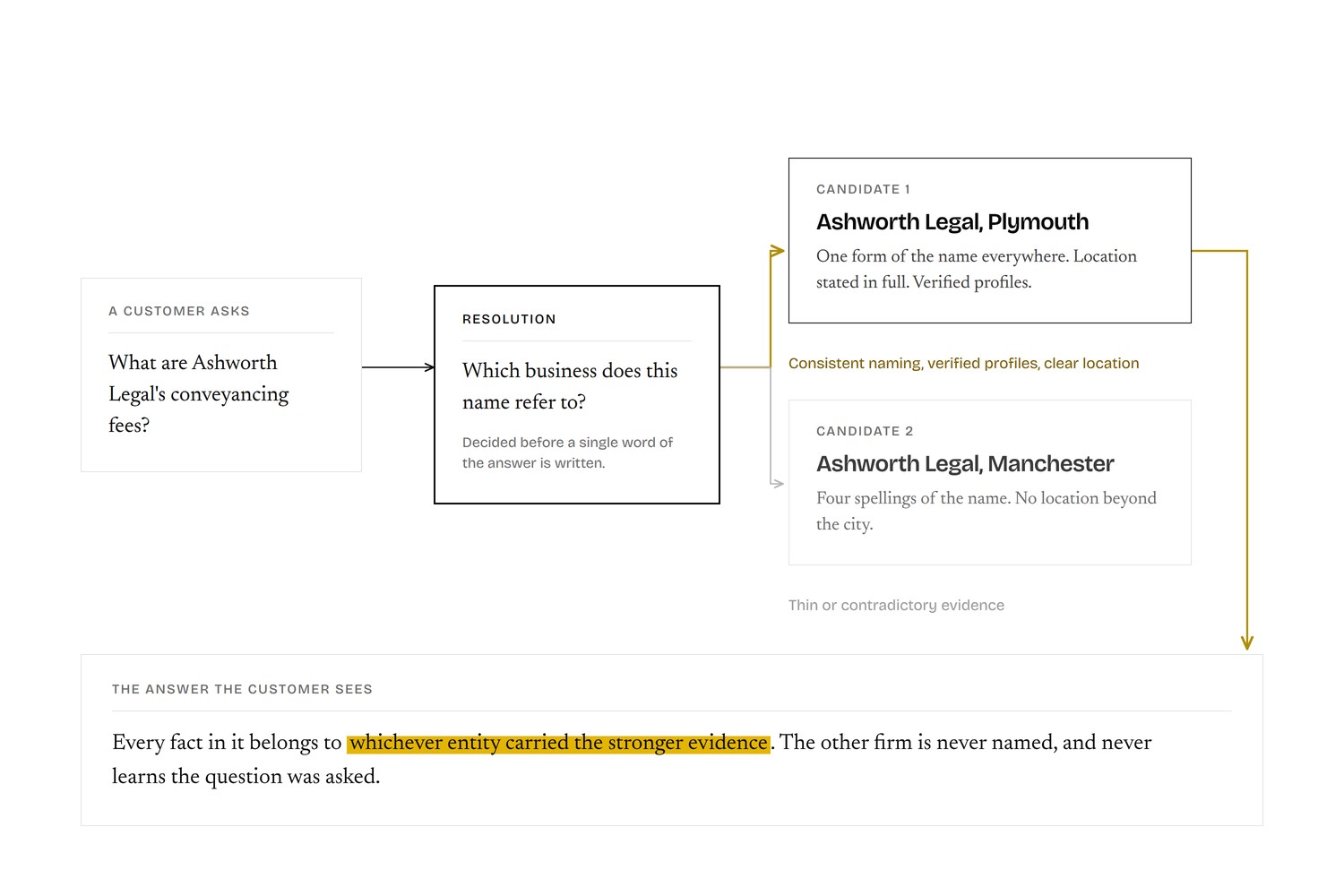
Entity resolution is the step where an assistant decides which real thing your name refers to. Before a model can say anything about a business, it has to match the words it has been given to one entity in its picture of the world, then retrieve the facts attached to that entity.
Google names two mechanisms behind its own generative features: retrieval-augmented generation, sometimes called grounding, which means the model fetches supporting material rather than answering from memory alone, and query fan-out, where one question is broken into several sub-queries (Google Search Central, published 15 May 2026, updated 10 July 2026). Both depend on the resolution step. Fetch material about the wrong entity and every sentence built on it is wrong, however well written.
Consider two firms trading as Ashworth Legal, one in Plymouth and one in Manchester. A customer asks an assistant about “Ashworth Legal's conveyancing fees”. The model has to pick. It will weigh which one has clearer, more consistent, more corroborated evidence attached to its name, and answer about that one. The Plymouth firm never sees the question and never sees the answer.
How does entity resolution break?
Entity resolution breaks through ambiguity, not through error. Four causes account for most of it: inconsistent naming, unclear location, markup that disagrees with the page, and a thin external record.
Take a builders' merchant near Tavistock registered as Tamar Building Supplies Ltd. The website header says Tamar Builders Merchants. The Google Business Profile says TBS Tamar. An old directory entry says Tamar Supplies. A human reads four labels for one yard. A model reads four candidate entities, each with a fragment of the evidence, none of them strong.
Location does the same damage. A law firm that says only “based in Plymouth” has told an American-trained model very little, because Plymouth is also a town in Massachusetts. The fix is unglamorous: the visible text says Plymouth, Devon, England, and says it in a place a crawler will reach.
Then there is markup. Structured data, which means machine-readable code describing what a page is about, is only useful when it is generated from the words visible on the page. Markup naming one organisation while the page names another is a contradiction, and a contradiction is worse than silence. Google's guidance is explicit that no special schema is required for its AI features and warns against over-focusing on structured data, so the value here is in agreement between the code and the text, not in volume of code.
The fourth cause is quieter than the other three. If nearly everything a model can find about a business sits on that business's own website, there is nothing to corroborate it, and a claim that appears in one place carries less weight than the same claim appearing in several. This is where an older, better-linked namesake wins: not because its evidence is better argued, but because there is more of it, in more places, agreeing with itself.
Why doesn't a ranking report show this?
Because a ranking report measures a different thing. It answers the question “where does this URL appear for this query”, and an entity failure happens on questions that never involve your URL at all. A dental practice can hold first place for “dental implants Exeter” all month and be absent from every AI answer about implant dentists in Exeter, with a rank tracker showing green throughout.
| A ranking problem | An entity problem | |
|---|---|---|
| What the customer sees | Your page sits lower in a list of links | An assistant names someone else, or describes you inaccurately |
| Where it shows up | Position tracking, search traffic | Only in the wording of an assistant's answer |
| What a ranking report says | The position, plainly | Nothing at all. Positions can be perfect throughout |
| What it responds to | Content, links, technical fixes | Consistent naming, unambiguous location, markup that matches the page, verified external profiles |
| How it is measured | Position for a query | Repeat prompting across several assistants |
The two are not alternatives, and both sit on the same foundations: a page has to be indexed and eligible for an ordinary snippet before it can appear in a Google AI answer at all. The difference is that one of them is measured by the reports most businesses already receive, and the other is not measured by anything unless somebody sets out to measure it.
How do you check whether it is happening to your business?
By asking, repeatedly, and writing down what comes back. There is no report to request and no dashboard that surfaces an entity failure, so the check is a deliberate one: a fixed set of questions, asked across several assistants, run enough times to distinguish a pattern from a one-off answer.
The repetition matters because the answers move. The same question put to the same model twice can name different businesses. Repeat runs are the method, not an optional extra: five answers to the same question give a proportion that can be recorded and compared month to month, where one answer gives an anecdote. First Mention runs a fixed query set monthly and asks each query five times within the run.
Several assistants matter for the same reason. ChatGPT is the largest single destination by some distance, with 1.8 billion UK visits in the first eight months of 2025 against 368 million in the same period of 2024, but it is not the whole picture: over the year to August 2025 Ofcom recorded Gemini up 146%, Claude up 138% and Perplexity up 100% (Online Nation 2025, published 10 December 2025). Checking one assistant tells you about one model's picture of your business, and the pictures differ.
For a hotel in Torquay, the query set would cover the obvious customer questions (“family hotels in Torquay with parking”, “is [hotel name] dog friendly”, “who runs [hotel name]”) and each answer would be recorded against four things: was the business named, was it named accurately, was it placed in the right town, and were the facts attached to it actually its own. Those are four separate failures, they have separate causes, and each one needs different work.
What does fixing it involve?
Making one entity easy to identify and hard to confuse. In practice that means one canonical form of the business name used everywhere, the same wording in the header, the footer, the Google Business Profile, Companies House and every directory entry that can be reached and edited.
Location and country go into visible text instead of being treated as obvious. Organisation markup is generated from that visible text, so the two never disagree. External profiles need to be verified and not merely present, because corroboration from a source the model already trusts does more than another sentence on your own site.
The work also includes checking that AI crawlers are allowed in. Crawlers are the automated programs that fetch pages, and robots.txt is the small file telling them what they may take. GPTBot, PerplexityBot and Google-Extended are frequently blocked by a platform or host default that nobody chose, and blocking them removes the business from those assistants entirely. This is a publishing decision rather than a security measure, and it is worth knowing which way it has been set.
One thing that will not help: llms.txt. Google states it does not use these files, and lists them among the machine-readable extras site owners can ignore for Google Search. A supplier presenting one as an AI visibility route is selling something the search company has published as ineffective.
What makes an assistant cite you once it has identified you?
Facts it can lift. Correct resolution only gets a business considered, and what turns consideration into a citation is whether the page carries specific, plainly worded, attributable information rather than description.
The first controlled experiment on this, by Aggarwal and colleagues at ACM SIGKDD in August 2024, tested 10,000 queries and found that citing sources, adding quotations and adding statistics each raised visibility by 30 to 40% on position-adjusted word count. The 40% is a maximum, not an average. The same study found keyword stuffing scored roughly 8% below doing nothing, which is a useful result: a long-standing search habit actively harms AI visibility.
A more recent preprint by Yu and colleagues, published 31 March 2026, held the wording identical and changed only structure, hierarchy and chunking, and recorded citation rates rising 17.3% across six generative engines. Two limits apply: it is an arXiv preprint that has not yet been peer reviewed, and the abstract does not name the six engines.
Query fan-out is what makes this practical. A guest typing “family hotel near Salcombe with parking and a dog-friendly room” is not running one search. The assistant may run four, covering parking, dog policies, family rooms and the area separately, then assemble one answer. For the hotel, that means the parking arrangements and the dog policy each need to exist as findable, plainly worded text, because each may be retrieved by a different sub-query. A PDF tariff and a paragraph implying dogs are welcome will not survive that process.
Questions people ask
How would I know if an AI assistant is describing my business wrongly?
You would not, from anything you already receive. Rankings, analytics and Business Profile insights all report on people who found you, and this failure happens to people who did not. Finding it means putting your own name and your customers' actual questions to several assistants and recording what comes back, several times over.
A single odd answer is an anecdote. Knowing whether it is a pattern, and which of the common causes is behind it, takes a fixed query set, repeat runs and a look at how the business is currently described and corroborated across the wider web. First Mention's AI visibility audit is built around that distinction.
My trading name is different from my registered name. Does that matter?
It matters, because it doubles the number of candidate labels a model has to reconcile. That is not a reason to change either name, but it is a reason to decide which form is canonical, use it consistently in visible text and markup, and make the relationship between the two explicit somewhere a crawler can read it.
Most businesses acquire these variants innocently, over years, through different people filling in different forms. A registered name, a trading name, an abbreviation used on invoices and a shortened version that fitted a directory field are four labels for one business. Pick one, then make the others point at it.
If I rank first on Google, can I still be left out of an AI answer?
Yes. Indexing and eligibility for a normal snippet are the entry requirements for Google's AI features, so ranking well helps, but they are not the same measurement. A business can hold first place for its main commercial query and still not be the business an assistant names when a customer asks for a recommendation.
The two questions being asked are different. A ranking answers “which pages are most relevant to this query”. An AI answer decides “which business should I tell this person about”, and that decision rests on how confidently the model can identify you and how much attributable evidence sits behind you.
Will adding more schema markup fix it?
No, and volume is the wrong instinct. Google states that no special schema is required for AI Overviews or AI Mode, and lists over-focusing on structured data among the things site owners can stop worrying about for Google Search. Markup helps when it agrees with the visible page and confuses matters when it does not.
The useful application here is narrow: organisation markup, generated from the words already on the page, stating the name, the location and the verified profiles that corroborate them. That is a consistency measure, not a ranking lever.
Should I add an llms.txt file to my site?
Not as an AI visibility measure. Google states it does not use these files, and names them among the special machine-readable formats that make no difference to Google Search. Some other tools and services do read them, so it is not harmful, but it belongs in the category of optional housekeeping rather than work that changes what an assistant says.
Keep the distinction in mind when you are buying, because it separates suppliers who read primary documentation from suppliers who read each other. Anything sold as an AI visibility deliverable should have a published source behind it.
The answers I get change every time I ask. Is the test even meaningful?
The variation is the reason for the method, not an argument against it. Answers vary between models and between runs of the same question, so any single answer is an anecdote. Asking a fixed query set five times per run, across several assistants, turns that noise into a distribution you can compare month to month.
What you are looking for is consistency: named four times out of five is a different situation from named once. A business that appears in two runs out of five has a different problem from one that never appears at all, and the two need different work.
Does this affect businesses whose customers are not using AI?
The premise itself needs testing. 54% of UK adults use AI tools such as ChatGPT, Copilot or Gemini, up from 31% the year before, and use is concentrated among younger adults, at 79% of 16 to 24 year olds and 74% of 25 to 34 year olds (Ofcom, Adults' Media Use and Attitudes 2026, published 2 April 2026).
A business serving an older customer base can reasonably assume most of its enquiries arrive by other routes. That is not the same as being unaffected, because AI summaries arrive whether or not a customer went looking for one. Google AI Overviews has passed 2.5 billion monthly active users and AI Mode has passed 1 billion monthly users (Google, June 2026). A retired couple searching for a solicitor in Truro in the ordinary way may be given a generated answer above the results without having asked for it. Being absent from that answer is not a problem confined to early adopters.
More answers are on the First Mention FAQ hub.
What to do next
An entity problem does not announce itself, and it will not appear in any report a business currently receives, so the sensible first step is to find out what the assistants actually say. If they are naming someone else, or describing work that is not yours, the causes are identifiable and the work to correct them is ordinary.
First Mention's AI visibility audit costs £950 and covers a fixed query set run five times each across the major assistants, an analysis of how the business is currently described and cited, and an in-person meeting to go through the findings.
Check visibilitySources
- Ofcom, Online Nation 2025, published 10 December 2025. ofcom.org.uk
- Ofcom, Adults' Media Use and Attitudes, published 2 April 2026. ofcom.org.uk
- Google, “New controls for website owners”, June 2026. blog.google
- Google Search Central, “Optimizing your website for generative AI features on Google Search”, published 15 May 2026, updated 10 July 2026. developers.google.com
- Aggarwal, Murahari, Rajpurohit, Kalyan, Narasimhan and Deshpande, “GEO: Generative Engine Optimization”, ACM SIGKDD, August 2024. arxiv.org
- Yu, MuFeng, Ding and Sato, “Structural Feature Engineering for Generative Engine Optimization”, 31 March 2026. arxiv.org